
Who audits your AI agents?
When AI becomes part of your workforce, how do you know it is doing the right thing?
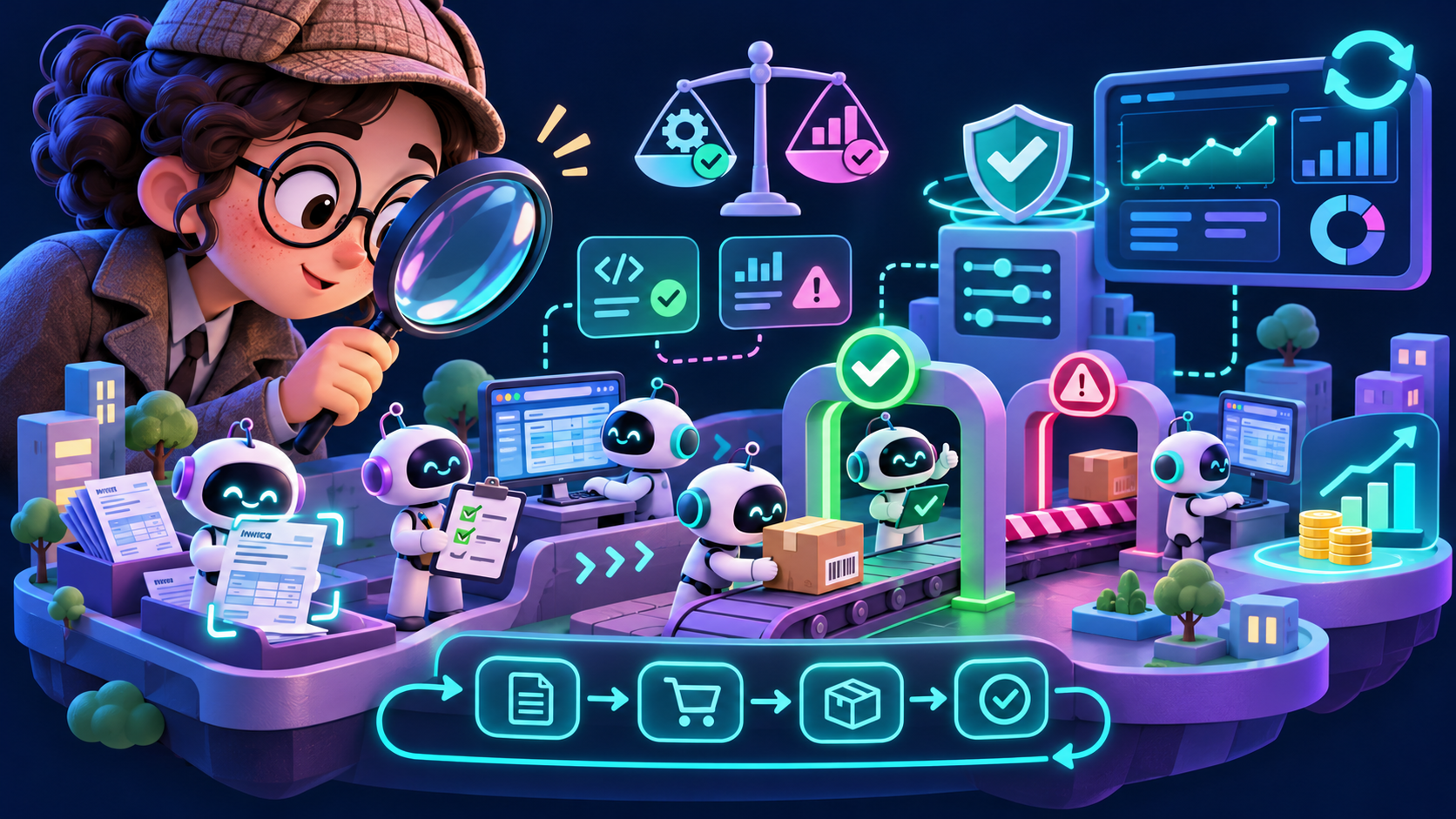
Imagine an AI agent working within your Accounts Payable (AP) function. The agent receives an invoice, interprets its contents, retrieves supplier details, checks the purchase order and posts the transaction into your ERP system.
The agent completes this task in seconds. Its technical logs show successful execution. No system errors. No failed API calls. The automation dashboard reports another successful transaction.
There is just one problem: the purchase order had not been approved, the invoice exceeded the agreed contract value, and the transaction should never have been posted without further review.
The technology worked. The business process failed!
As organisations move from AI chat use and assistants towards autonomous and semi-autonomous agents, we need to fundamentally rethink how we assess the performance, reliability and risks of AI. Much of the current discussion focuses on how to build better agents, connect them to business systems and give them the tools to perform increasingly complex tasks. Far less attention is given to what happens afterwards.
Who is independently monitoring what these agents actually do, whether their actions comply with business requirements, and whether they deliver the intended outcomes?
1. From generating answers to taking actions
Where an AI assistant can read and summarise a document for someone to review, an AI agent takes the next step itself if it has permission. It might check an invoice against a purchase order in one system and post it to the finance system. If it mistakes a pending approval for a completed one, it could post an invoice that should have gone to a person for review.
The same risk applies when an agent updates a customer record or initiates external conversation. Once AI can take action, teams need to check that the action was authorised and the result intended.
| Dimension | AI assistant | AI agent |
|---|---|---|
| Primary purpose | Generate information and recommendations | Execute tasks and achieve objectives |
| Decision-making | Primarily human-led | Increasingly delegated |
| System interaction | Often limited or read-only | Potentially able to create, change and execute transactions |
| Execution | Typically individual requests | Potentially complex, multi-step workflows |
| Business risk | Incorrect or misleading information | Incorrect information and unauthorised or inappropriate actions |
| Assurance focus | Quality of responses | Quality of decisions, actions and business outcomes |
This does not mean every AI agent represents a significant business risk. An agent summarising internal documents requires a very different level of oversight from one authorising financial transactions or assessing customer eligibility.
The level of governance should be proportionate to the agent's capabilities, autonomy, access permissions and potential consequences.
This is increasingly reflected in industry guidance. The Australian Signals Directorate, together with cybersecurity agencies from New Zealand, the United States, Canada and the United Kingdom, published Careful Adoption of Agentic AI Services, addressing the distinct risks associated with integrating agents into operational environments.
The OWASP Top 10 for Agentic Applications 2026 similarly highlights risks involving agent objectives, tool usage, identity, permissions and interactions between agents.
The conversation is moving beyond hallucinations. It is increasingly about what AI is permitted to do, what it actually does and how organisations retain control.
2. An AI agent is another participant in your business process
We should stop treating AI agents exclusively as technology components.
From a business process perspective, an agent is another participant in the execution of work. It receives information, performs activities, makes or recommends decisions, interacts with systems and hands work over to others.
In many respects, this is no different from how employees, external service providers and traditional automation solutions participate in business processes.
Organisations have spent decades establishing controls around these participants:
- Delegations of authority and approval limits.
- Segregation of duties.
- Access management and authorised system activities.
- Quality assurance and exception management.
- Performance indicators and service-level agreements.
- Transaction monitoring and independent assurance.
Why should an AI agent performing equivalent business activities be subject to fundamentally less scrutiny?
Consider a procurement agent that identifies a suitable supplier, creates a purchase order and follows up on delivery. The organisation may have spent considerable time testing the agent's ability to interpret requests and select suppliers.
But has it assessed whether the agent consistently purchases from approved suppliers, respects contractual arrangements, operates within delegated limits and avoids creating segregation-of-duties conflicts?
What happens if two different agents, operating under separate instructions, collectively circumvent a control that would have prevented an individual employee from performing the same combination of activities?
These are not simply technical AI risks. They are familiar operational, financial and compliance risks introduced through a new execution mechanism.
That distinction matters because accountability should remain with the business function that owns the process, rather than being transferred entirely to the technology team that developed the agent.
3. Observability is not the same as assurance
Agent observability is developing rapidly, and for good reason.
Engineering teams need visibility into how agents operate, which models they use, what tools they invoke, how they handle errors and how much their execution costs.
Emerging OpenTelemetry conventions for generative AI and agent operations are helping establish more consistent approaches to capturing this information across different technologies and frameworks.
This is an important development. But it does not solve the entire problem.
Technical observability helps us understand what happened inside the application. Business assurance requires us to understand what happened to the business.
Three levels of AI oversight
| Level | Question | Evidence |
|---|---|---|
| Technical observability | Did the agent execute correctly? | Tool calls, errors, latency, token consumption |
| Process intelligence | What actually happened in the business process? | Transactions, activities, handoffs, decisions, controls |
| Business assurance | Were the actions appropriate and outcomes acceptable? | Compliance, financial impact, risk exposure, customer outcomes |
A successful API response confirms that a request was accepted by a system. It does not necessarily confirm that the resulting transaction was appropriate.
An agent reporting that it has successfully completed a task is similarly insufficient evidence that all business requirements have been met.
Organisations need the ability to connect technical execution data with independently recorded business activities and outcomes. This includes validating what was actually created or changed in the ERP, CRM, claims management or other operational systems.
There is an important principle here: the same agent performing an activity should not be the sole source of evidence that the activity was performed correctly.
We would not design a financial control framework around employees simply confirming that they followed the rules. We should be equally cautious about relying on AI agents to assess their own compliance.
4. The missing connection: agent telemetry and business process data
This is where Process Mining becomes particularly interesting.
Traditional Process Mining uses historical and ongoing system activity to reconstruct how business processes actually operate. It provides visibility into process variations, bottlenecks, rework, handoffs, control deviations and performance outcomes.
By incorporating AI agent activities into this analytical environment, organisations can start to understand how agents influence the wider business process rather than assessing them in isolation.
Imagine being able to compare the complete execution of a claims management process across cases handled by employees, traditional automation, AI agents and combinations of all three.
We could investigate whether AI-assisted cases genuinely result in faster settlements, fewer errors, better customer outcomes and lower handling costs. We could also identify whether faster processing comes at the expense of missing approvals, inappropriate decisions or increased downstream rework.
The technical prerequisite is establishing reliable relationships between agent execution records and business transactions.
A well-designed agent should record sufficient structured information to support this, including its identity, version, task, relevant tool invocations, transaction references and outcomes. Business systems provide complementary evidence of what was actually executed.
For complex scenarios involving multiple invoices, purchase orders, customers or agents, object-centric Process Mining may provide a more appropriate analytical approach than forcing every activity into a single case identifier.
None of this requires capturing every internal model reasoning step. In fact, indiscriminately storing prompts and responses can introduce additional privacy and security risks. The objective is to retain meaningful, proportionate and reliable evidence of decisions, actions and outcomes.
5. Measure the agent's contribution, not just its activity
Counting how many tasks an agent completes is tempting. It is easy to instrument and makes for an impressive dashboard. But a high automation rate is not necessarily a good business outcome.
Consider two hypothetical invoice-processing agents, each handling 10,000 comparable invoices. Agent A processes 95% without human intervention, but 8% of all invoices require downstream correction. Agent B processes 85% without intervention and only 1% require correction. Agent A has the higher automation rate; Agent B generates 700 fewer corrections. If each correction takes 15 minutes, that is 175 hours of downstream effort avoided. Whether Agent B is cheaper overall also depends on the effort involved in its additional human reviews, technology costs and the consequences of errors.
A meaningful assessment needs both Key Performance Indicators (KPIs) and Key Risk Indicators (KRIs).
| Indicator | What it reveals |
|---|---|
| End-to-end cycle time | Whether the whole process becomes faster, not just the automated step |
| First-time-right rate | Whether completed transactions require subsequent correction |
| Cost per successful case | Model, integration, human review and rework costs combined |
| Human intervention rate | Where the agent needs assistance or escalates appropriately |
| Approval bypass rate | Whether required approvals are missing before execution |
| Unauthorised actions | Attempted or completed activities outside delegated permissions |
| Duplicate or inconsistent transactions | Whether retries or interacting agents create unintended results |
| Outcome disparities | Whether comparable customer or employee groups experience materially different outcomes |
| Performance by agent version | Whether changes in models, prompts, tools or policies coincide with deteriorating outcomes |
Establish a historical baseline before deployment. Compare comparable cases and account for changes in volume, complexity and policy. An agent assigned only simple cases should not automatically be credited with outperforming employees handling complex exceptions.
The objective is not to maximise autonomy. It is to maximise sustainable business value within acceptable risk boundaries.
6. Build controls into the environment, not just the prompt
The evolution from prompt engineering towards agent harnesses is a welcome development. The harness determines how an agent accesses tools, receives context, handles failures and operates within its environment. But even a well-designed harness needs enforceable controls and independent evidence.
Telling an agent not to approve payments above a certain amount is an instruction. Configuring an authorisation service that rejects such payments unless an independent approval exists is a control.
The difference is fundamental.
For material actions, organisations should consider least-privilege identities, narrowly scoped tools, transaction-level authorisation, separation of read and write access, independent approval gates, idempotency controls to prevent duplicate execution, and the ability to suspend or revoke access quickly. Logs should be protected from alteration by the agent they monitor. Critical controls should fail safely if approval or authorisation evidence is missing.
Monitoring complements these preventive measures. It does not replace them. AI can help investigate patterns and suggest root causes, but a model-generated explanation is a hypothesis until supported by evidence. A second AI agent may assist with review, yet using another model does not automatically create independent assurance, especially when both share the same data, tools or failure modes.
The NIST AI Risk Management Framework places governance, measurement and risk management across the AI lifecycle. Australia's Guidance for AI Adoption similarly emphasises accountability and ongoing governance. These are useful foundations, not substitutes for controls designed around specific business risks.
7. So, who actually audits the agents?
The answer is not simply internal audit. Effective governance requires distinct responsibilities across the organisation.
The Institute of Internal Auditors' AI Auditing Framework builds on the Three Lines Model. Applied to agentic workflows, it offers a useful way to allocate responsibilities without blurring ownership and independent assurance.
| Role | Responsibility for agentic AI |
|---|---|
| Governing body | Set expectations for risk appetite, accountability and oversight of material AI deployments. |
| First line – process owners and delivery teams | Own agent-related business outcomes, maintain controls, monitor exceptions and remediate issues. Engineering teams maintain the technical environment. |
| Second line – risk and compliance | Establish risk requirements, challenge assessments, review exposure and monitor adherence to policies. |
| Third line – internal audit | Independently assess governance, control design and operating effectiveness, including the reliability and completeness of monitoring evidence. |
A shared analytical view can help all three lines work from consistent transaction-level evidence. It must not mean that internal audit operates the controls it later audits or that management delegates accountability to an AI monitoring tool.
Continuous monitoring is a management capability. Continuous assurance requires appropriately independent evaluation. The two can reinforce each other without being interchangeable.
8. Six questions to ask before your next agent goes live
- Who owns the business outcome? Identify an accountable process owner, not only a technical product owner.
- What can the agent actually do? Document its access, delegated authority, dependencies and prohibited actions.
- Which controls are enforced independently? Test what happens when approvals are missing, information is incomplete or execution is retried.
- Can we reconstruct an agent-driven transaction? Link the agent's identity, version, relevant actions and approvals to independently recorded business events.
- How will we know it delivers value? Establish baseline KPIs and KRIs, monitoring thresholds, escalation responsibilities and a review cadence.
- Can we safely stop, investigate and recover? Define suspension, access revocation, reconciliation and remediation procedures, and test them before deployment.
Start with agents that can materially affect financial transactions, customer outcomes, sensitive information or critical operations. Expand the monitoring coverage as autonomy and exposure increase.
The real opportunity: make AI accountability part of the business process
We are at an interesting point in the evolution of enterprise AI. Organisations are building increasingly capable agents, and there is significant potential to improve productivity, service quality and decision-making. But autonomy without accountability is not a mature operating model.
The organisations that succeed will not necessarily be those deploying the largest number of agents. They will be those that understand where agents create value, where they introduce risk and how to continuously improve the interaction between people, AI and business systems.
At Intellifold, we see an opportunity to extend Process Mining, Data Analytics and AI into this emerging area of operational governance. By bringing agent execution data together with business system records, organisations can establish a foundation for monitoring performance, identifying control exceptions, investigating root causes and measuring actual business outcomes. Agent-specific connectors and monitoring rules need to be designed for each environment; the approach is not a claim that every agent platform is already supported out of the box.
The ambition should not be to slow AI adoption through additional bureaucracy. It should be to build the evidence and confidence that allow organisations to adopt AI more effectively, at greater scale and with appropriate oversight.
Before asking how many AI agents your organisation can deploy, ask whether you can account for what they do.